Nilupa Gunarathna
Experimental physicist exploring atomically thin materials through light

Hi! I’m Nilupa.
I am a PhD student in physics at Binghamton University and an experimental researcher studying atomically thin materials.
My research focuses on synthesizing these materials and using light-based techniques to uncover their structure and properties.
By understanding these extremely thin materials, we can help develop future optical and electronic technologies.
Beyond the laboratory, I am passionate about science communication. I enjoy making complex scientific ideas clear, engaging, and accessible to everyone.
Welcome to my website! Explore my work to discover how atomically thin materials are created, how lasers reveal their invisible properties, and what everyday life inside a physics laboratory looks like.
Physics Outreach
The Invisible World Revealed by Light!
Created with support from the Digital Scholarship & Communication (DS&C) Fellowship at Binghamton University, this science communication project offers a closer look at how light can be used to investigate materials that are too small to see with the naked eye.
Through laboratory photographs, accessible explanations, and examples from my research, the project introduces visitors to atomically thin materials, crystal synthesis, lasers, Raman spectroscopy, and everyday experimental physics.
Bringing Physics Beyond the Laboratory
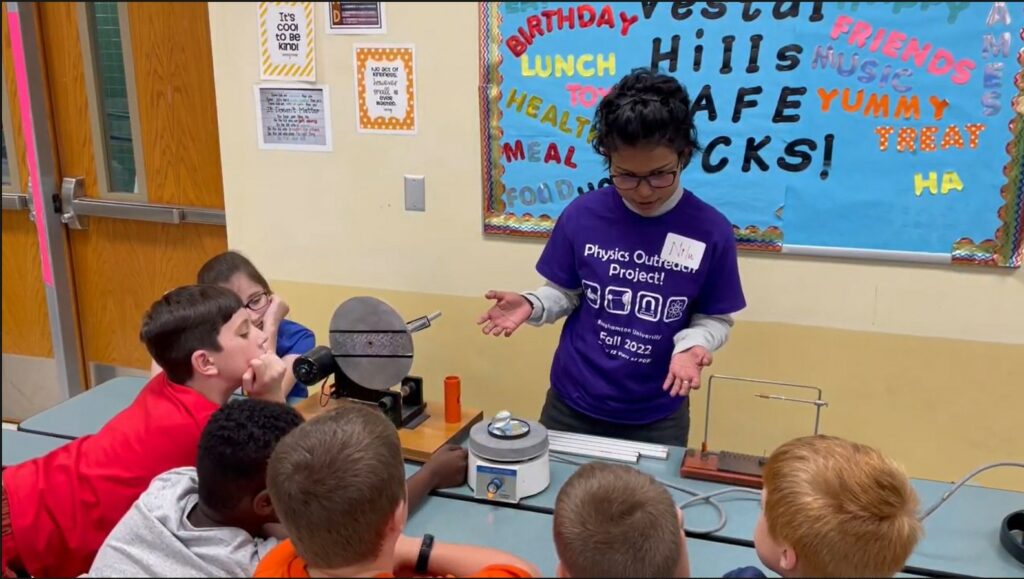
For two years, I volunteered with Binghamton University’s Physics Outreach Project (POP), helping introduce physics to students and community audiences through interactive demonstrations.
POP brings entertaining, hands-on science programs to audiences of all ages, with a particular focus on elementary school students who may have limited exposure to physics. These experiences allow me to share my enthusiasm for science while developing creative ways to explain physical concepts.
Explore the Outreach Gallery


Sharing My Research
Conference Posters
Explore a selection of posters I have presented at conferences and research events. These posters highlight my work on atomically thin materials, nanostructures, optical spectroscopy, and experimental characterization.
View the posters below ↓
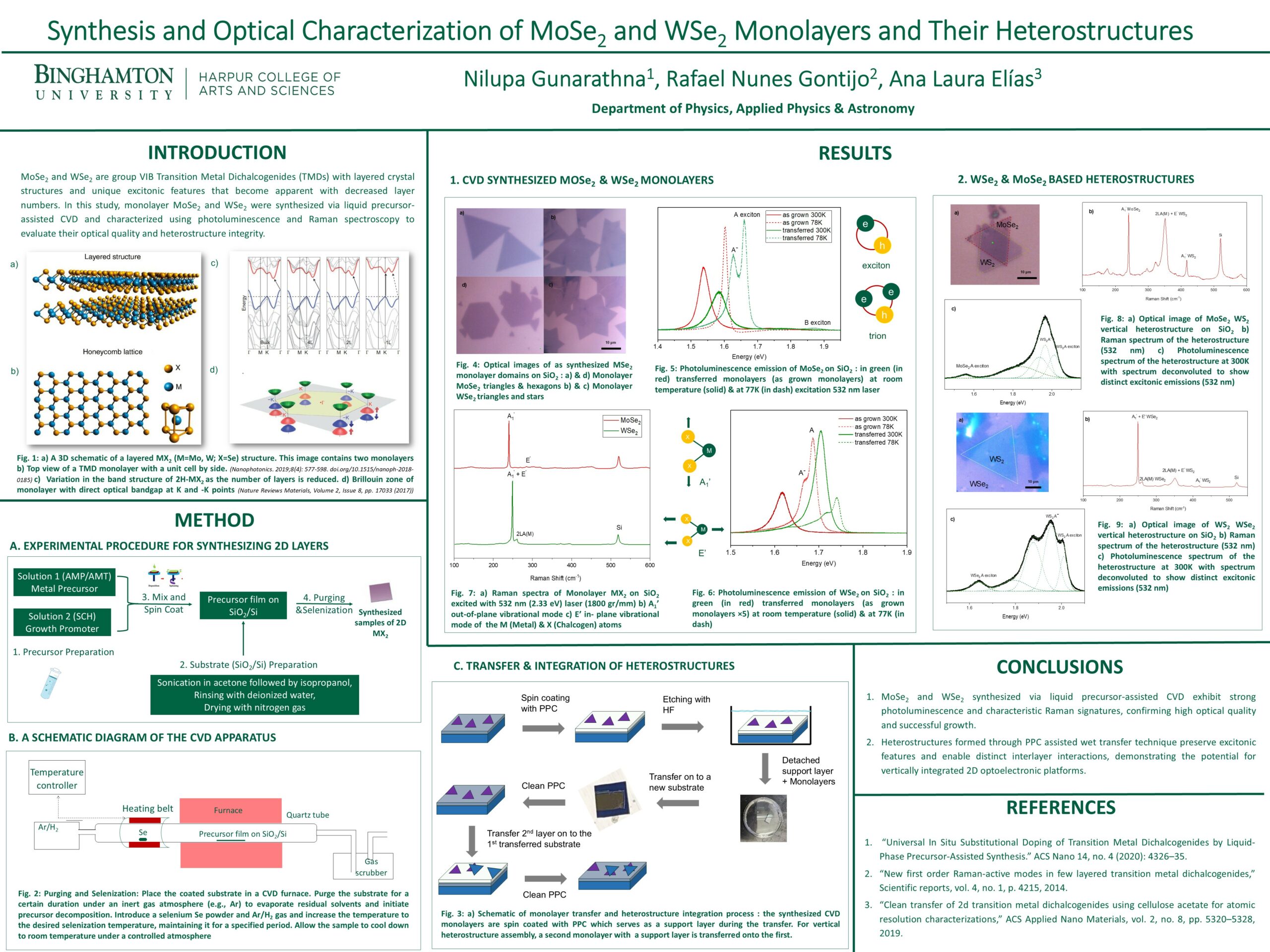
1. “Synthesis and Optical Characterization of MoSe2 and WSe2 Monolayers and Their Heterostructures”, Nilupa Gunarathna, Rafael Nunez Gontijo, Ana Laura Elias. 131st APS NYSS Spring 2025, Quantum Physics and Its Impact on Modern Society, St. John’s University, New York, NY. 1st Place – Graduate Student Poster Section.
Poster 1
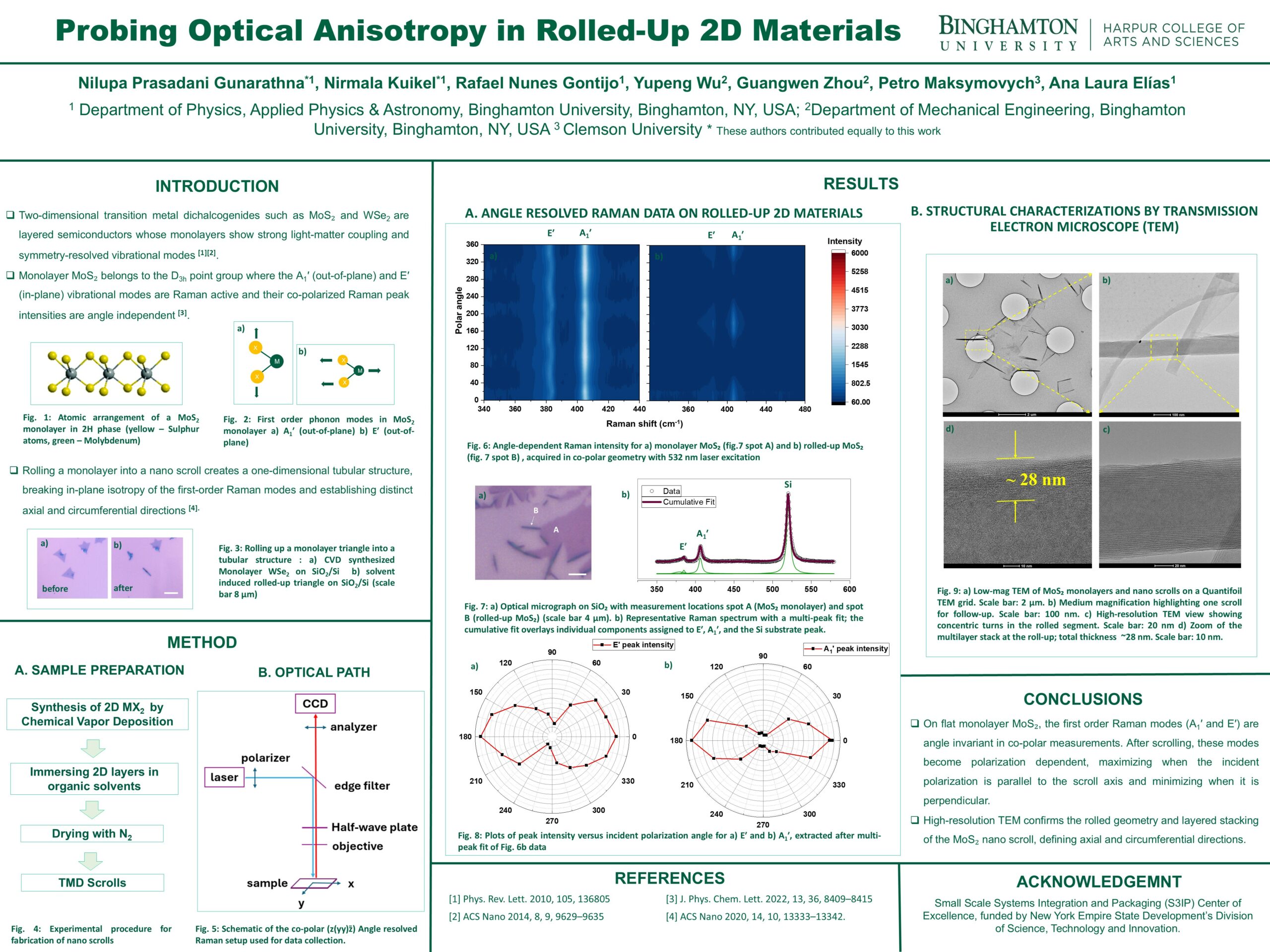
2. “Probing Optical Anisotropy in Rolled-Up 2D Materials”, 2025 Annual Meeting of the Mid-Atlantic Section
Poster 2
Talks
1. Curvature-Induced Raman Anisotropy and Excitonic Resonance Shifts in Scrolled Monolayer MoS2 and WSe2, APS Global Physics Summit 2026,
Non-Carbon Nanostructures – Physical Properties and Applications, in-person oral presentation at the Colorado Convention Center in Denver, Colorado, 03/16/2026.
Abstract
Monolayer transition metal dichalcogenides (TMDs) such as MoS2 and WSe2 exhibit D₃h point group symmetry, yielding an isotropic out-of-plane A₁′ Raman mode under co-polarized excitation. Here, we report that this isotropy is broken when the monolayers are transformed into quasi-one-dimensional scrolls. The transformation is induced by immersing CVD-grown monolayer TMDs in organic solvents such as ethanol. Upon drying, spontaneous Marangoni-driven forces roll the initially triangular or hexagonal monolayers into filament-like scrolls without any mechanical manipulation. Raman measurements reveal a pronounced polarization dependence of the A₁′ mode in the scrolled structures: its intensity is maximized when the excitation polarization is aligned parallel to the scroll axis and suppressed when perpendicular. The silicon substrate’s Raman signal served as an internal polarization reference to validate the measurement geometry. This emergent anisotropy indicates curvature-induced perturbations to phonon eigenmodes and the local dielectric environment, effectively lowering the crystal symmetry and coupling out-of-plane vibrations to in-plane optical fields. Under 473 nm excitation, monolayer MoS2 and WSe2 domains display a distinct 2LA resonance associated with the C exciton, whereas this feature vanishes in the scrolled configurations, suggesting that curvature detunes the C exciton resonance and modifies electron-phonon coupling. To further probe the structure, selected nanoscrolls were transferred onto TEM grids for detailed imaging, complemented by AFM characterization of the scroll morphology.